
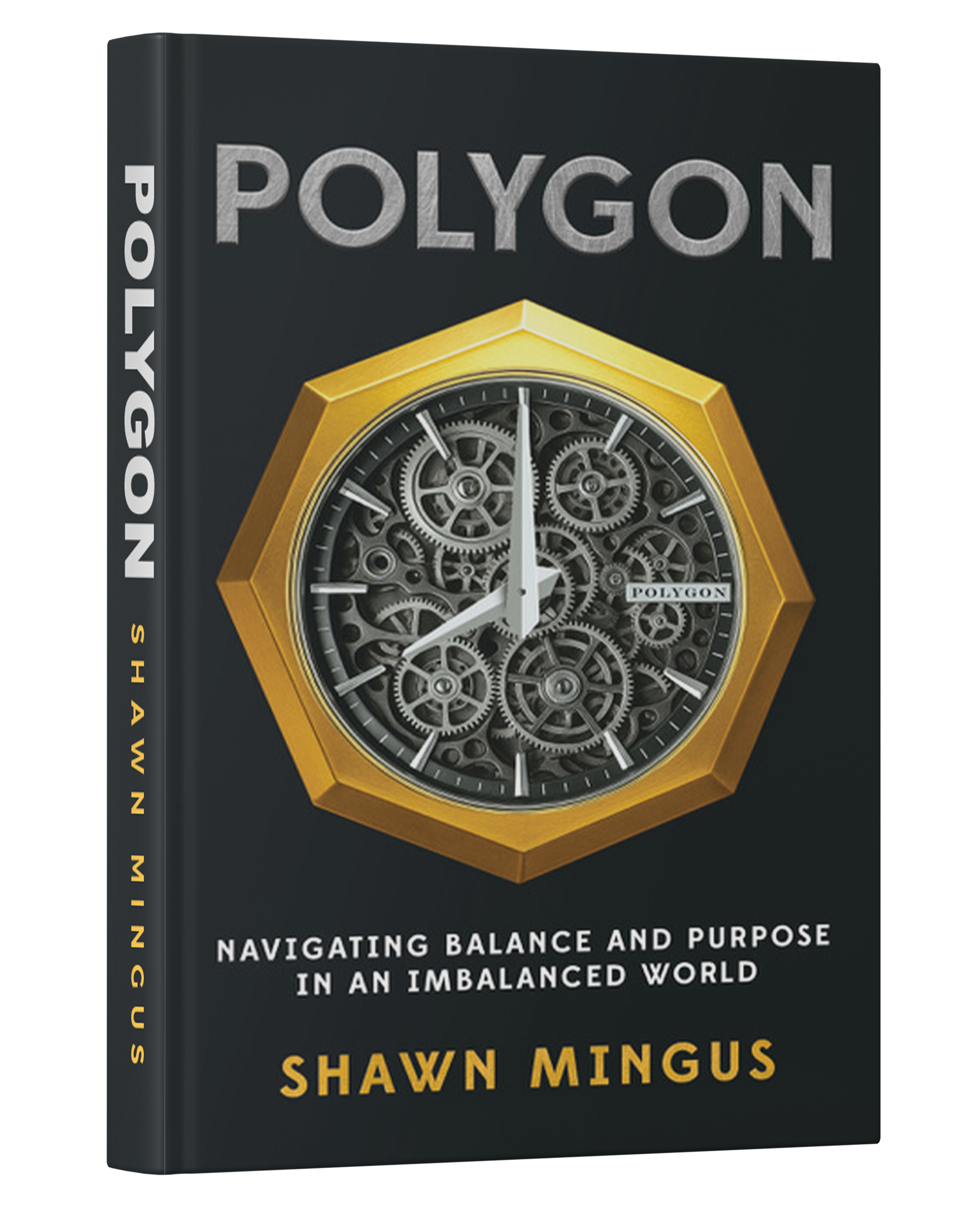
ABOUT THE BOOK
Driven by the belief that “knowing what truly matters” is the real path to prosperity, Mingus developed The Balance Polygon—an eight-dimensional framework designed to help people navigate balance and purpose in an imbalanced world. Through it, he equips readers to navigate life’s transitions with intention and direction.
intro - The turning point
I began daydreaming at an early age, and in many ways, it became a hopeful companion that helped carry me through dark times. Daydreaming took my mind far away from the present and into the future, where I could see a different version of myself—without fail, a better one. I used dreaming as a survival tool. It gave me hope. But what I didn’t realize at the time was that hope alone wasn’t enough. I needed discipline—discipline to change myself rather than wait for change to find me.
Fast forward to 2004.
In November of that year, I attended an exclusive conference in Miami led by The CORE Training, a sales coaching organization. The event was called “Surviving Change,” and it took place in luxurious rooms with white linen tablecloths and all the hallmarks of a four-star hotel. I remember Rick Ruby, the head coach, opening the morning session to a packed audience of two hundred sales professionals from around the country. Rick was on fire that day—bold, energetic, captivating—as he urged us to break free from our comfort zones and push through the real-world challenges of sales and success. As we sat in groups of ten, his energy filled the room and captured my full attention.
After about an hour of stirring vision-casting, Rick transitioned to a segment titled “The Wheel of Life.” That moment changed me. I remember it vividly. That morning session didn’t just inspire me—it transformed me. In fact, it was so impactful that I went on to share The Wheel of Life tool with thousands of people over the next nineteen years.
At the time, I was a thirty-seven-year-old sales executive, happily married with two healthy young boys. Life looked good on the outside. We had great friendships, a supportive extended family, a beautiful neighborhood, healthy habits, and a regular exercise routine. I was reading often and in good physical shape. And yet, deep down, I felt incomplete. Deficient, somehow. I couldn’t see a clear purpose for my life, and I didn’t know why—especially after investing so much into myself over the previous three years. I had hired a coach, read widely, explored Native American traditions, meditated, analyzed dreams, and practiced Tai Chi with Master Robert Larsen. But I was still searching.
Martial arts had been part of my journey since I was twelve. It gave me discipline and helped me confront both my physical and mental limits. For me, becoming a black belt was never about toughness or being above others—it was about perseverance and balance. A black belt is simply proof that you’ve developed the discipline to overcome challenges in pursuit of something worthy. I’ve earned four degrees in Taekwondo: my first at age fourteen, the second at seventeen, the third at fifty-one, and the fourth at fifty-four. Each level brought new obstacles—intense physical training, scheduling demands, and the reality of aging. I’ve broken my nose twice, fractured nearly every toe, broken several fingers, torn both PCLs, and suffered more hamstring tears than I can count. I wanted to quit many times. But a black belt doesn’t quit. And neither did I.
Tai Chi, however, was a different beast entirely. Compared to the explosive energy of Taekwondo, Tai Chi is a moving meditation. It was the most challenging physical training I’ve ever encountered—not because of speed or power, but because of the internal focus it demanded. It required me to start and end each day with 30 minutes of slow, deliberate movement. The practice became a bookend to my day and a mirror for my energy. And that level of presence was exhausting for someone with a fast-paced mind like mine.
One day during practice, I asked Sifu Robert Larsen—who was nearly seventy at the time—what he believed was most important for creating balance. Before I could even finish the question, he gracefully dropped to the ground right at my feet. I was stunned. He looked up at me, smiled, and said one word: “Trust.” Then he popped back to his feet without injury and said again, “Balance requires our absolute trust. When we trust life, we can live and move with balance.”
In that moment, I didn’t just hear wisdom—I saw it lived out. Sifu Larsen wasn’t just explaining trust. He was embodying it. His response became a defining lesson for me: trust isn’t theoretical. It’s physical. It’s spiritual. It’s lived.
When I begin learning a new Taekwondo form, the movements always feel unnatural. I’m hesitant. My eyes drift down. My breath is off. My strikes lack precision and confidence. I’m disconnected, trying to control something that doesn’t yet feel like mine. And if others are watching, that vulnerability only intensifies. But over time, I break the form down—first into segments, then into micro-movements. I repeat each part until it starts to feel natural. Eventually, the whole form flows with power and purpose. My eyes are up. My breathing is steady. My body is aligned. And trust—real, grounded, embodied trust—is what makes it all possible.
Building trust in ourselves is no different than building it with others. It takes time. It takes evidence. And it can be broken in a moment. Sadly, many people never fully trust others or themselves. But trust is the gateway to a balanced life. Without it, we feel scattered, unsafe, powerless. We’re not fully present because we’re stuck in the past or anxious about the future. Biologically, this connection is real: oxytocin, often called the “love hormone,” is tied to both love and trust. We are quite literally wired to connect—to ourselves and others. And just like earning a black belt, building trust in ourselves takes training. It takes repetition. It takes showing up when we least feel like it.
In fact, those days—when we’re tired, uncertain, and full of doubt—are the days we need training the most. Because finishing a workout or sticking to a promise when everything in us wants to quit is the most powerful kind of growth. It’s how we earn trust with ourselves. It’s how we build confidence in our ability to follow through.
But most people don’t get that far. Consider how many New Year’s resolutions are made each year—promises to lose weight, quit smoking, get in shape. According to research, only 9% of Americans actually complete their resolutions. By the end of the first week, 23% have already quit. By the end of January, nearly half have given up. What do you think that does to someone’s confidence? What happens to our self-trust when we fail ourselves over and over again?
This is why the first step matters so much. Imagine setting out to visit your neighbor to the east and taking your very first step in the opposite direction. You’ve immediately made the journey more difficult or, maybe even impossible. That’s why, when it comes to building balance, discovering purpose, and reclaiming trust, the first step must be intentional. It must be in the right direction.
If you’ll let me, I’d like to be your guide. One of my life’s purposes is to help others reach their full potential. The chapters ahead will walk you through a clear, practical process to help you find your starting point. It will reveal your blind spots and help you move forward step by step with purpose. The visual feedback tool you’ll use will help you reflect, identify imbalances, and take meaningful action. And when you write down the steps you’re committed to taking, you’ll likely find that you’ve done more for your life balance in those moments than you ever have before.
And that’s a big deal because those early wins begin to rebuild trust. You’ll start to believe in yourself again. You’ll start to see progress. You’ll start to become stronger.
Just like learning a Taekwondo form, this process starts slow. But over time, as each move becomes familiar and each pattern becomes natural, you’ll experience something powerful: clarity, presence, peace. And it works. In 2020, I earned the title of World Champion in traditional forms and that same year, I was elevated to Vice President of a top-five bank.
This process is what got me there.
And it’s what will help you get where you’re meant to go.